Context: SubjectWell needed blog content centered on thought leadership for the clinical trial industry. After surveying SubjectWell’s patients through the company’s private call center, the marketing team analyzed and reported on the data in individual blog articles.
Contributions: Initial Pitch, Survey Design and Content, Article Copy, and Social Media Copy.
Results: Increased LinkedIn followers for the SubjectWell page upon posting each article, as well as increased word-of-mouth for SubjectWell at industry events. (Many visitors to the SW booth mentioned these articles as their favorite industry marketing content.)
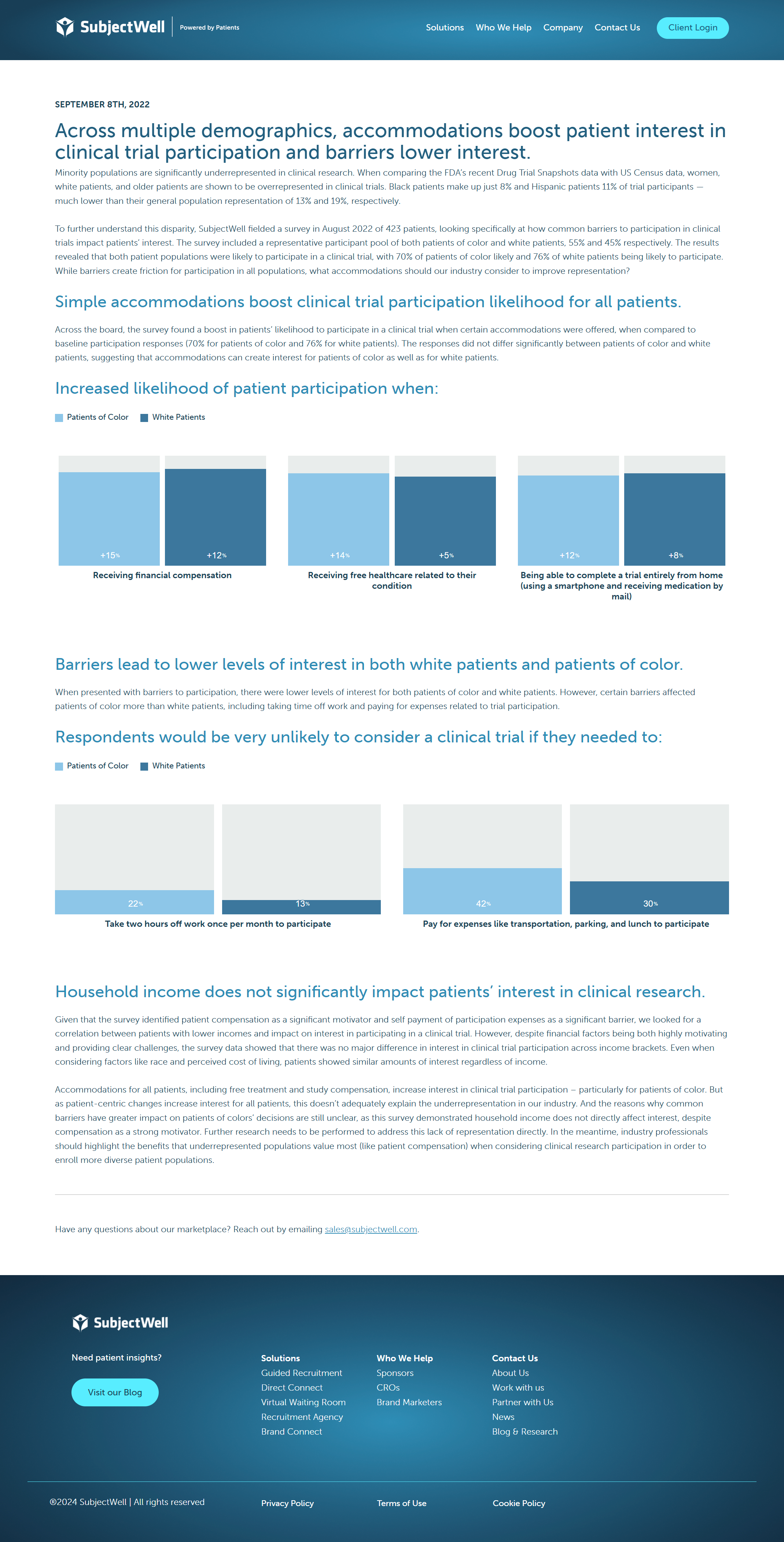
Across multiple demographics, accommodations boost patient interest in clinical trial participation and barriers lower interest.
View Article Copy
Minority populations are significantly underrepresented in clinical research. When comparing the FDA’s recent Drug Trial Snapshots data with US Census data, women, white patients, and older patients are shown to be overrepresented in clinical trials. Black patients make up just 8% and Hispanic patients 1% of trial participants — much lower than their general population representation of 13% and 19%, respectively.
To further understand this disparity, SubjectWell fielded a survey in August 2022 o f 423 patients, looking specifically at how common barriers to participation in clinical trials impact patients’ interest. The survey included a representative participant pool of both patients of color and white patients, 5% and 45% respectively. The results revealed that both patient populations were likely to participate in a clinical trial, with 70% of patients of color likely and 76% of white patients being likely to participate. While barriers create friction for participation in all populations, what accommodations should our industry consider to improve representation?
Simple accommodations boost clinical trial participation likelihood for all patients.
Across the board, the survey found a boost in patients’ likelihood to participate in a clinical trial when certain accommodations were offered, when compared to baseline participation responses (70% for patients of color and 76% for white patients). The responses did not differ significantly between patients of color and white patients, suggesting that accommodations can create interest for patients of color as well as for white patients.
Barriers lead to lower levels of interest in both white patients and patients of color.
When presented with barriers to participation, there were lower levels of interest for both patients of color and white patients. However, certain barriers affected patients of color more than white patients, including taking time off work and paying for expenses related to trial participation.
Household income does not significantly impact patients’ interest in clinical research.
Given that the survey identified patient compensation as a significant motivator and self payment of participation expenses as a significant barrier, we looked for a correlation between patients with lower incomes and impact on interest in participating in a clinical trial. However despite financial factors being both highly motivating and providing clear challenges, the survey data showed that there was no major difference in interest in clinical trial participation across income brackets. Even when considering factors like race and perceived cost of living, patients showed similar amounts of interest regardless of income.
Accommodations for all patients, including free treatment and study compensation, increase interest in clinical trial participation — particularly for patients of color. But as patient-centric changes increase interest for all patients, this doesn’t adequately explain the underrepresentation in our industry. And the reasons why common barriers have a greater impact on the decisions of patients of color are still unclear, as this survey demonstrated household income does not directly affect interest, despite compensation as a strong motivator. Further research needs to be performed to address this lack of representation directly. In the meantime, industry professionals should highlight the benefits that underrepresented populations value most (like patient compensation) when considering clinical research participation in order to enroll more diverse patient populations.
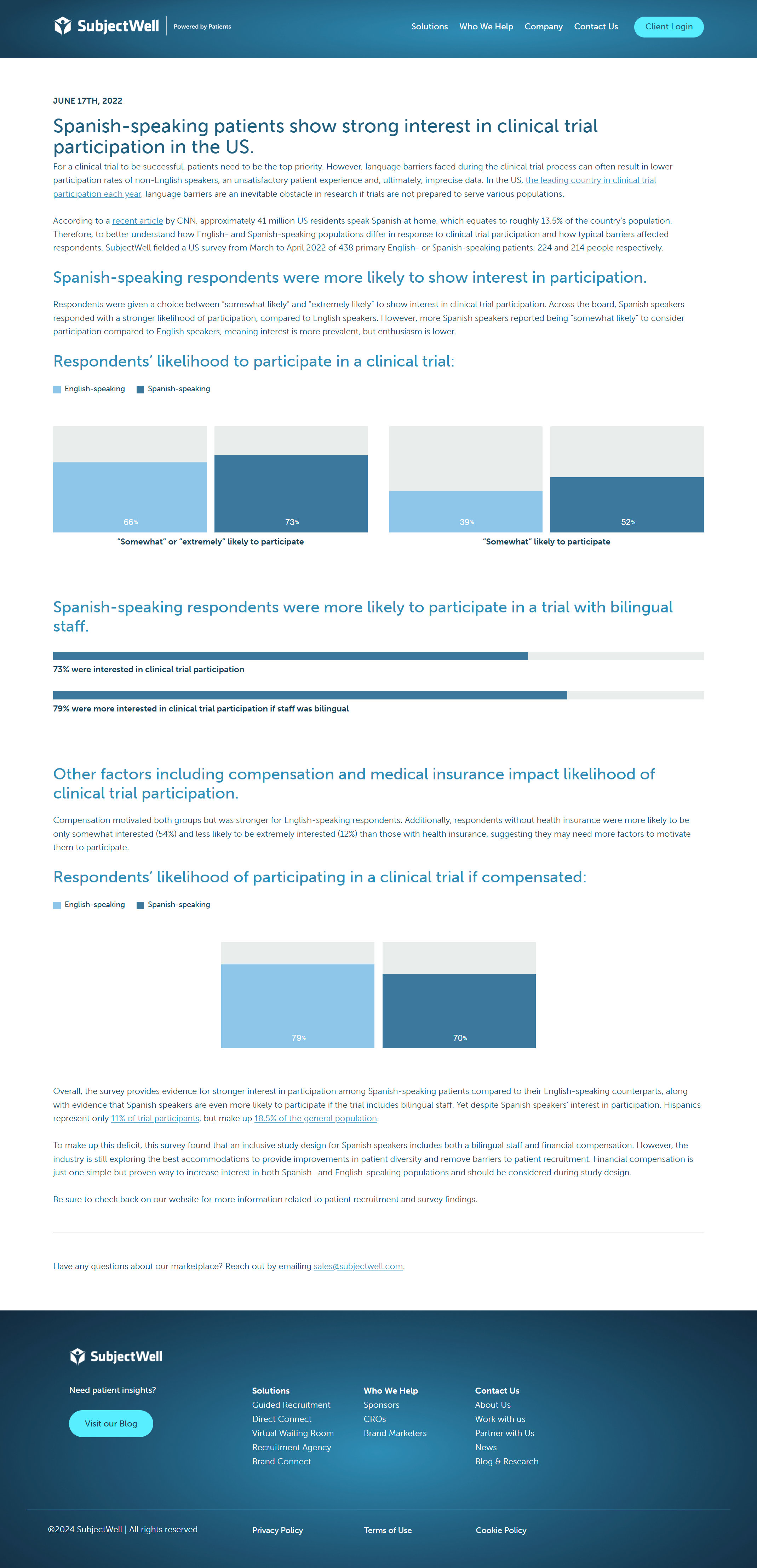
Spanish-speaking patients show strong interest in clinical trial participation in the US.
View Article Copy
For a clinical trial to be successful, patients need to be the top priority. However, language barriers faced during the clinical trial process can often result in lower participation rates of non-English speakers, an unsatisfactory patient experience and, ultimately, imprecise data. In the US, the leading country in clinical trial participation each year, language barriers are an inevitable obstacle in research if trials are not prepared to serve various populations.
According to a recent article by CNN, approximately 41 million US residents speak Spanish at home, which equates to roughly 13.5% of the country’s population. Therefore, to better understand how English- and Spanish-speaking populations differ in response to clinical trial participation and how typical barriers affected
respondents, SubjectWell fielded a US survey from March to April 2022 of 438 primary English- or Spanish-speaking patients, 224 and 214 people respectively.
Spanish-speaking respondents were more likely to show interest in participation.
Respondents were given a choice between “somewhat likely” and “extremely likely’ to show interest in clinical trial participation. Across the board, Spanish speakers responded with a stronger likelihood of participation, compared to English speakers. However, more Spanish speakers reported being “somewhat likely” to consider participation compared to English speakers, meaning interest is more prevalent, but enthusiasm is lower.
Spanish-speaking respondents were more likely to participate in a trial with bilingual staff.
73% were interested in clinical trial participation
79% were more interested in clinical trial participation if staff was bilingual
Other factors including compensation and medical insurance impact likelihood of
clinical trial participation.
Compensation motivated both groups but was stronger for English-speaking respondents. Additionally, respondents without health insurance were more likely to be only somewhat interested (54%) and less likely to be extremely interested (12%) than those with health insurance, suggesting they may need more factors to motivate them to participate.
Overall, the survey provides evidence for stronger interest in participation among Spanish-speaking patients compared to their English-speaking counterparts, along with evidence that Spanish speakers are even more likely to participate if the trial includes bilingual staff. Yet despite Spanish speakers’ interest in participation, Hispanics represent only 11% of trial participants, but make up 18.5% of the general population.
To make up this deficit, this survey found that an inclusive study design for Spanish speakers includes both a bilingual staff and financial compensation. However, the industry is still exploring the best accommodations to provide improvements in patient diversity and remove barriers to patient recruitment. Financial compensation is just one simple but proven way to increase interest in both Spanish- and English-speaking populations and should be considered during study design.
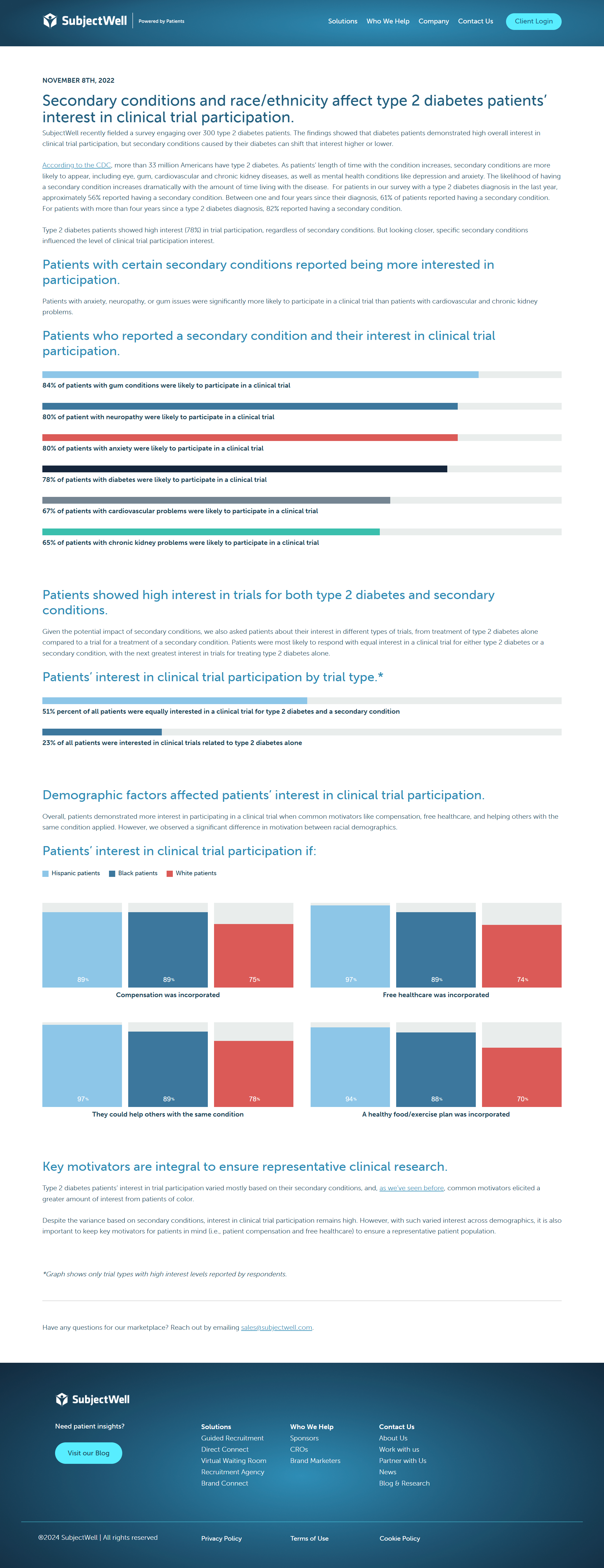
Secondary conditions and race/ethnicity affect type 2 diabetes patients’
interest in clinical trial participation.
Due to a reliance on images and graphs, the text version of this article is unavailable. Please view the PDF or PNG above.
 Eric Chase